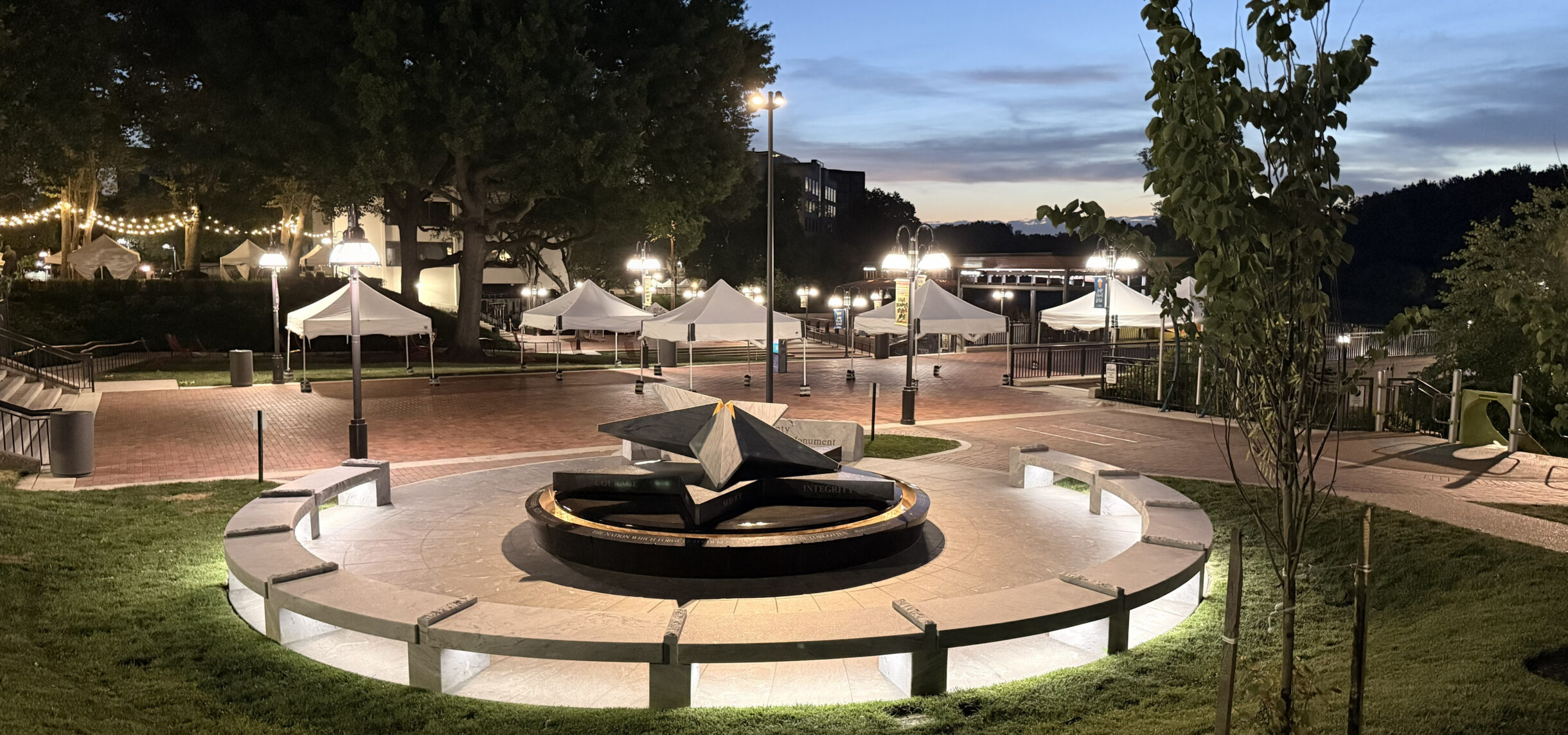
How water and stone give remembrance a lasting form.

INSIGHT: Howard County Veterans and Military Family Memorial

How water and stone give remembrance a lasting form.

Built twice

Before the fountain became part of the Howard County Veterans and Military Families Monument in Columbia, Maryland, the complete granite structure was assembled, checked and tested at the Kusser workshop in Aicha vorm Wald. The stone modules, water-bearing surfaces, joints and technical details came together at full scale inside the production environment. After this review, the fountain was prepared for container-optimized transport to the United States. The completed monument was opened and dedicated at Vivian C. "Millie" Bailey Park on May 14, 2026, after a decade of planning, designing and building by the Howard County Veterans Foundation.

Three stars, four stones

The monument's design by artist Larry Kirkland is built around three symbolic stars. The Blue Star honors veterans and their families, recalling the tradition of hanging a blue star when a loved one is serving. The community star forms the base and represents the community that supports military families while their loved ones serve. At the center, a Gold Star remembers those who have fallen in the line of duty. Kusser translated this symbolism into a precise composition of natural stone: the Blue Star was fabricated from Azul Blue Granite, the community star from Labrador and water table and surrounding wall is Angola. Further solid construction elements were produced from Fürstensteiner. Each material defines a specific part of the fountain and gives the monument its layered visual character.

Solid build for moving water

The fountain was fabricated as a modular (engineered) natural stone construction. Large granite components were cut, shaped and prepared in the workshop, with each module assigned to a defined position in the system. Visible surfaces, water-bearing geometry, joints and technical interfaces were coordinated before the fountain reached the site. This method is central to Kusser's work on complex fountain systems: solid natural stone modules are produced with high precision, assembled in a controlled environment and prepared for reliable installation. The stone forms the visible surface, the body of the fountain and part of the technical system at the same time.

Details that carry the system

Edges guide the lines of the stars, slopes control the movement of water, joints connect the modules into one surface, and openings, rebates and connection points prepare the later installation of the water system. During production, machining, fitting and checking turned individual stone elements into a coordinated fountain system. Each stone part was made for a specific position, and the accuracy of each module influenced the final geometry of the complete structure.

The Blue Star in Azul Blue Granite

The Blue Star is the most prominent element of the fountain. It recalls the long-standing tradition in which families hung a blue star when a loved one was serving. The star is set at an angle, pointing upward toward the heavens, to symbolize the prayers offered for a safe and joyful reunion. In the monument, it honors veterans and their families. Fabricated from Azul Blue Granite, the star brings this meaning into the material reality of the fountain. Its geometry, surface and color were coordinated with the surrounding basin, the water level and the overall composition, creating a central stone element that carries meaning and function within the complete water feature.

Meaning carved into stone

The community star, fabricated from Labrador Dunkel, represents the wider community supporting military families while their loved ones serve. Its ten faces are engraved with values such as honor, courage, sacrifice, duty, integrity, liberty and faith.

The reflecting pond and surrounding rim are formed in Angola granite. The water symbolizes loss, healing and renewal, while inscriptions around the edge give voice to the principles of service, freedom and remembrance.

“With freedom comes responsibility.”

— Eleanor Roosevelt

“The nation which forgets its defenders will be itself forgotten.”

— Calvin Coolidge

“The greatest strength in performing our mission comes from the encouragement we receive from our loved ones at home.”

— William E. Elliot, Jr.

Tested with water before shipment

The fountain was assembled and tested in Aicha before it was packed. This allowed the team to review the alignment of the modules, the behavior of the water and the interaction of the stone components as one complete working system. For public fountains, this workshop phase turns production into verification: the fountain is seen, assembled and tested before shipping and installation begin. Public Art Services documented that artist Larry Kirkland and Creative Project Manager John Grant traveled to Kusser Graniteworks in Germany during the project to check on the progress of the monument.

Prepared for the Atlantic crossing

The modules were separated, protected, labeled and packed for container-optimized shipping. For a fountain built from solid granite, this transport preparation is part of the project logic. Each piece has weight, geometry and a defined position in the later assembly. The fountain left Aicha as a tested system, broken down into transportable modules and prepared for reassembly in the United States.

Reassembled in Maryland
In Maryland, the fountain became part of a public place of remembrance that brings together star symbolism, natural stone, water and public space. The work behind the finished fountain began long before the public dedication: with material selection, machining, modular construction, test assembly and functional review in Aicha. Built once in Germany, reassembled in Maryland, the fountain now forms the center of a monument dedicated to veterans, service members, military families and those who lost their lives in service.

1    Project: Howard County Veterans and Military Families Monument
2    Location: Vivian C. “Millie” Bailey Park, Columbia, Maryland, USA
3    Client / Project Initiator: Howard County Veterans Foundation
4    Artist: Larry Kirkland
5    Creative Project Management: Public Art Services / John Grant
6    Granite Fountain Fabrication: Kusser Granitwerke GmbH, Aicha vorm Wald, Germany
7    Materials: Azur Blue Granite, Labrador Hell, Labrador Dunkel, Tittlinger Feinkorn
8    Local Installation: in coordination with local project partners
9    Major Grant Providers: Howard County, Maryland; State of Maryland
10  Land Donor: Howard Hughes

Visit "Howard County Veterans" Website

MORE INSIGHTS

Back to overview