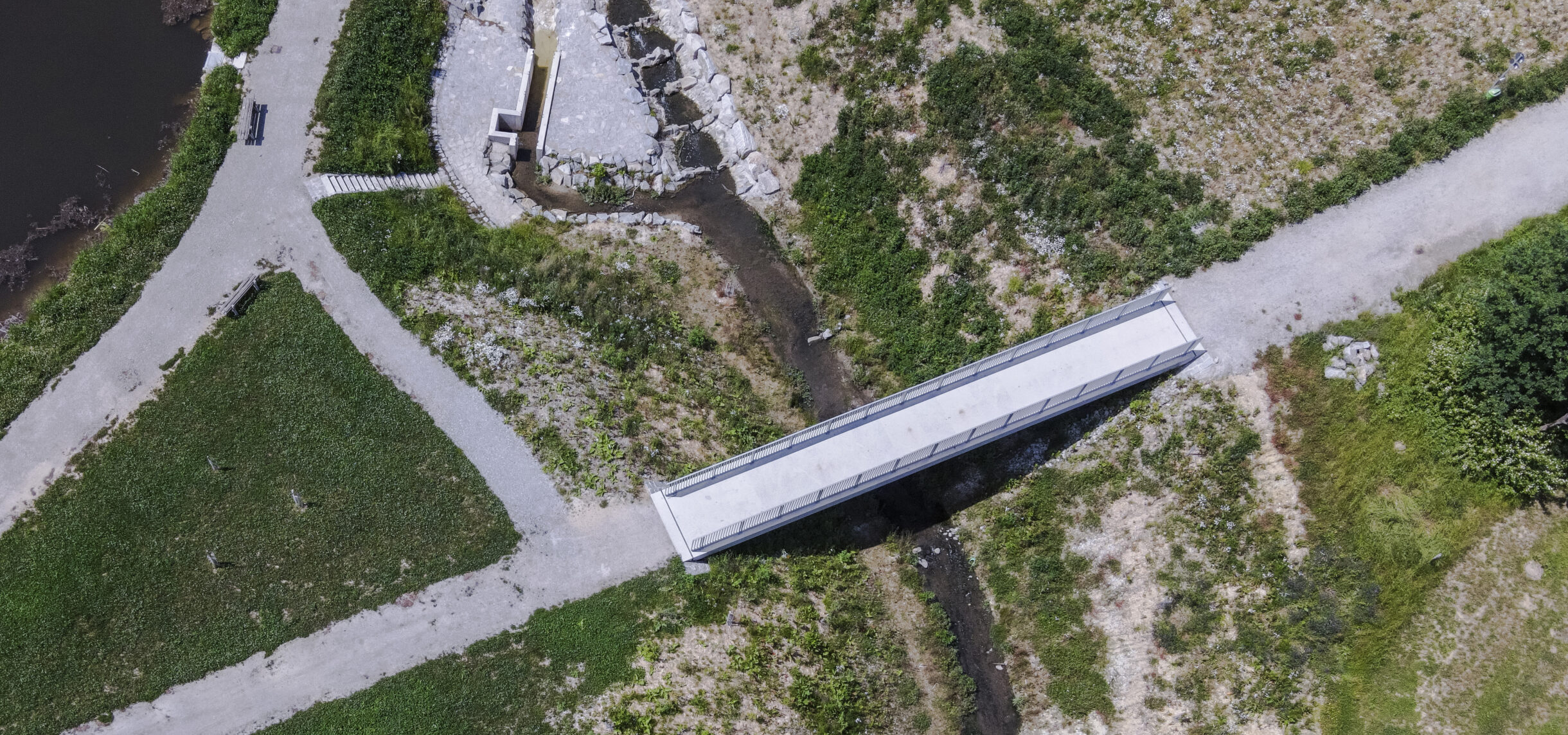
The purpose of bridges is to overcome boundaries. Kusser’s post-tensioned granite bridges take that definition literally. They provide spans of up to 20 m, at thicknesses of a mere 15 to 50 cm, with no additional structures, coverings, or coatings. Refined engineering connects two banks in a more environmentally friendly way than ever before. So for us, sustainability begins with material selection. Our granite is extracted from our own quarries. There is no need for kiln firing, concrete casting, or chemical treatment. This means that our post-tensioned granite bridges simultaneously deliver an exceptionally low carbon footprint and an important innovation, ensuring an investment in future-proof infrastructure. What we build today should still be here for generations to come.
With a total weight of some 77 tonnes, the structure spans 20 m with a low construction height of just 50 cm. This makes it the longest single-span, load-bearing, post-tensioned granite bridge ever built. Unteriglbach, Ortenburg - 2021
Benefits
Factory-finished
During construction and assembly in the factory, our bridges undergo 100% quality checks; each segment is produced with millimeter -accuracy, the steel tendons set accurately and the rails integrated.
Quick installation
The bridges are supplied fully preassembled and can be erected in just one day.
Barrier-free
With minimal joints, slip-resistant surfaces, and no need for ramps in suitable site conditions, our bridges can provide accessible crossings. When designed for the required loads, they can also accommodate emergency vehicles.
Floodwater protection
The slender design offers more than aesthetic advantages. Its reduced structural depth provides increased clearance beneath the bridge during flooding. As demonstrated in the Neuhaus am Inn project, railings can also be designed for quick removal when severe weather is anticipated.
Versatile
Beyond the cost savings, post-tensioned granite also delivers on looks. Slim enough to be installed at a construction height of just 15 cm, these elements are a real alternative to precast concrete in innovative building projects. Their applications range from architectural features such as balconies on townhouses to ceiling elements.
German technical approval Z-13.4-150, issued by DIBt
The structure consists of solid granite segments joined by high-strength post-tensioning steel. Granite’s high compressive strength contributes to a durable, structurally stable bridge with a slender profile. Beyond its appearance, the system offers practical advantages in construction and long-term performance.
A Fresh Take on Economy
Built to last well over 100 years, granite bridges pay off in the long run. They offer low operating costs, exceptional durability, and a timeless yet modern look. Because the granite serves as both the structural and the visible surface, no extra protective layers or coatings are needed. With costly maintenance largely eliminated, these bridges are an especially appealing choice for municipalities and private developers alike.
Post-tensioning technology for pedestrian and bicycle bridges. Railing heights must meet applicable project requirements and local codes. Side-mounted railings can provide additional clear width.
Assembly & installation
Planning
Each bridge is planned individually to meet project requirements. Requirements regarding load-bearing capacity, railings, and path connections are included in the project planning phase, then considered by our engineering team.
Manufacture
The manufacture of post-tensioned granite bridges begins with raw blocks of Tittling fine-grain granite from our own quarry. These are sawn into individual segments with the required surface treatments. The required space for the tensioning steel wire strands is milled in the middle pieces or drilled in the side sections. Then the individual elements are glued together and tensioned. After this, the holes are sealed and the railings fitted.
Preparation
At the start of installation, the site-provided abutments are measured with millimetre accuracy. Grouting frames are used to compensate for construction tolerances. These are installed before the bridge is placed on the abutments. Likewise, temporary supports and lashing points are also fitted to facilitate installation.
Bridge Installation
A truck-mounted crane lifts the bridge into position on its abutments. This is a major milestone in the installation process and often attracts interest from project stakeholders and the public. The specified bridge bearings and any required connecting stone elements are then installed in accordance with the engineered details.
Finishing work
The temporary steel supports are removed and, if necessary, expansion joints are installed to ensure the bridge is finally ready for use.
Slenderness is our strength
Post-tensioned granite bridges can provide slender, durable crossings for pedestrians and cyclists. Depending on site conditions, their low structural depth and slip-resistant surface can support accessible designs. Where required, bridges can also be engineered for emergency vehicle loads.
Tested, approved and proven.
More than 100 bridges in Germany and internationally, including one in Stevenage, near London, demonstrate the practicality and versatility of post-tensioned bridges. They have been subject to regulatory approval by the German Institute for Building Technology (DIBt) and been awarded construction technique permit number Z-13.4-150.